Engineering Productivity Across Distributed Teams in 2025
As global engineering teams stretch across continents, productivity depends less on headcount and more on structure. In this article, Carbon explores how nearshore and BOT-model teams in 2025 are achieving measurable performance gains through process maturity, data transparency, and cultural alignment.

In 2025, every technology company faces the same paradox: talent has never been more distributed, and yet productivity expectations have never been higher. At Carbon, we see this tension daily; scaling engineering output while teams span continents and time zones. The question has evolved from “How do we hire engineers fast?” to “How do we sustain productivity once we do?”
Engineering productivity is no longer about how many lines of code a developer commits. It’s a function of system maturity: process efficiency, alignment, collaboration quality, and cultural trust. For distributed teams, particularly those structured under Build-Operate-Transfer (BOT) or nearshore delivery models, measurable productivity comes from operational design, not proximity.
Redefining Engineering Productivity
The traditional image of productivity (velocity points or feature counts) is being replaced by more robust, data-driven metrics.
High-performing organizations now rely on DORA metrics (DevOps Research & Assessment) and SPACE framework indicators, which combine quantitative and qualitative insights:
- Deployment frequency
- Lead time for changes
- Change failure rate
- Mean time to recovery
The DORA framework, popularized by Google’s research group, found that elite performers deliver software 973x more frequently and recover 6,570x faster than low performers. However, these elite metrics depend heavily on team maturity, workflow automation, and cross-team collaboration quality; all areas where distributed or nearshore teams can outperform traditional setups when correctly structured.
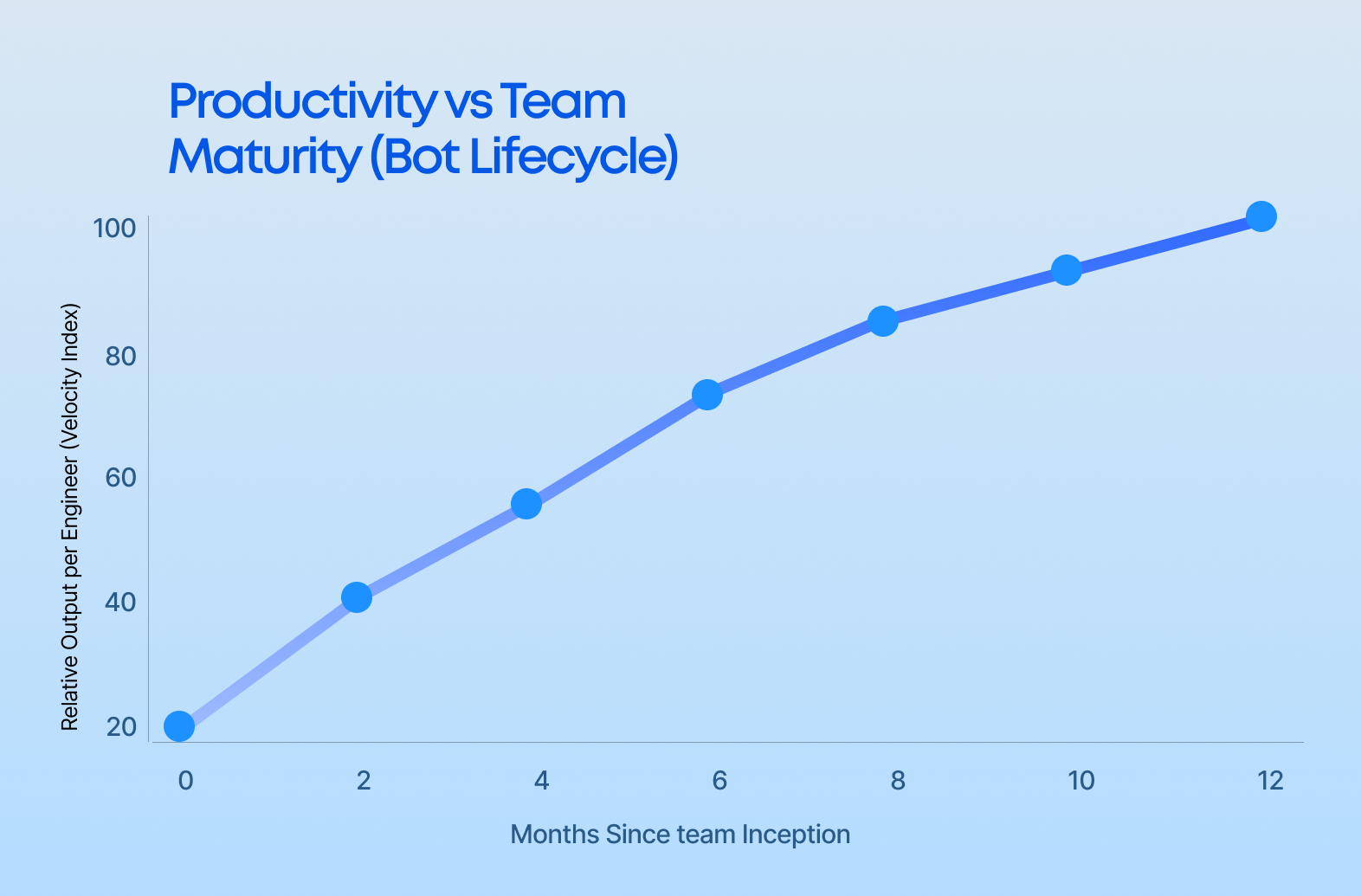
The Productivity–Maturity Curve
Early-stage teams often face ramp-up inefficiencies: context switching, unclear ownership, or tooling debt.
Carbon’s aggregated delivery data shows that distributed engineering teams typically hit their first productivity inflection point around months 5–6, once roles, rituals, and review processes stabilize.
Below, we visualize this trend using a simplified, representative model based on internal benchmarks and DORA velocity correlations.
Measuring Distributed Team Performance
Quantifying distributed engineering productivity requires careful instrumentation. Combining objective and behavioral metrics across several dimensions:
Technical Metrics
- DORA metrics for delivery velocity
- Code review turnaround time (PR time to merge)
- Deployment cadence per engineer
- Defect density and post-release issue rates
Collaboration and Culture Metrics
- Cycle time vs communication frequency correlation (GitPrime, now Pluralsight Flow, measures this at code level)
- Async-sync balance ratio, tracking dependency on real-time meetings
- Onboarding time to first productive commit
This aligns with Atlassian’s Engineering Effectiveness research, which found that shorter feedback loops (below 16 hours) have the strongest correlation with sustained velocity.
Regional Performance Insights: Nearshore Advantage
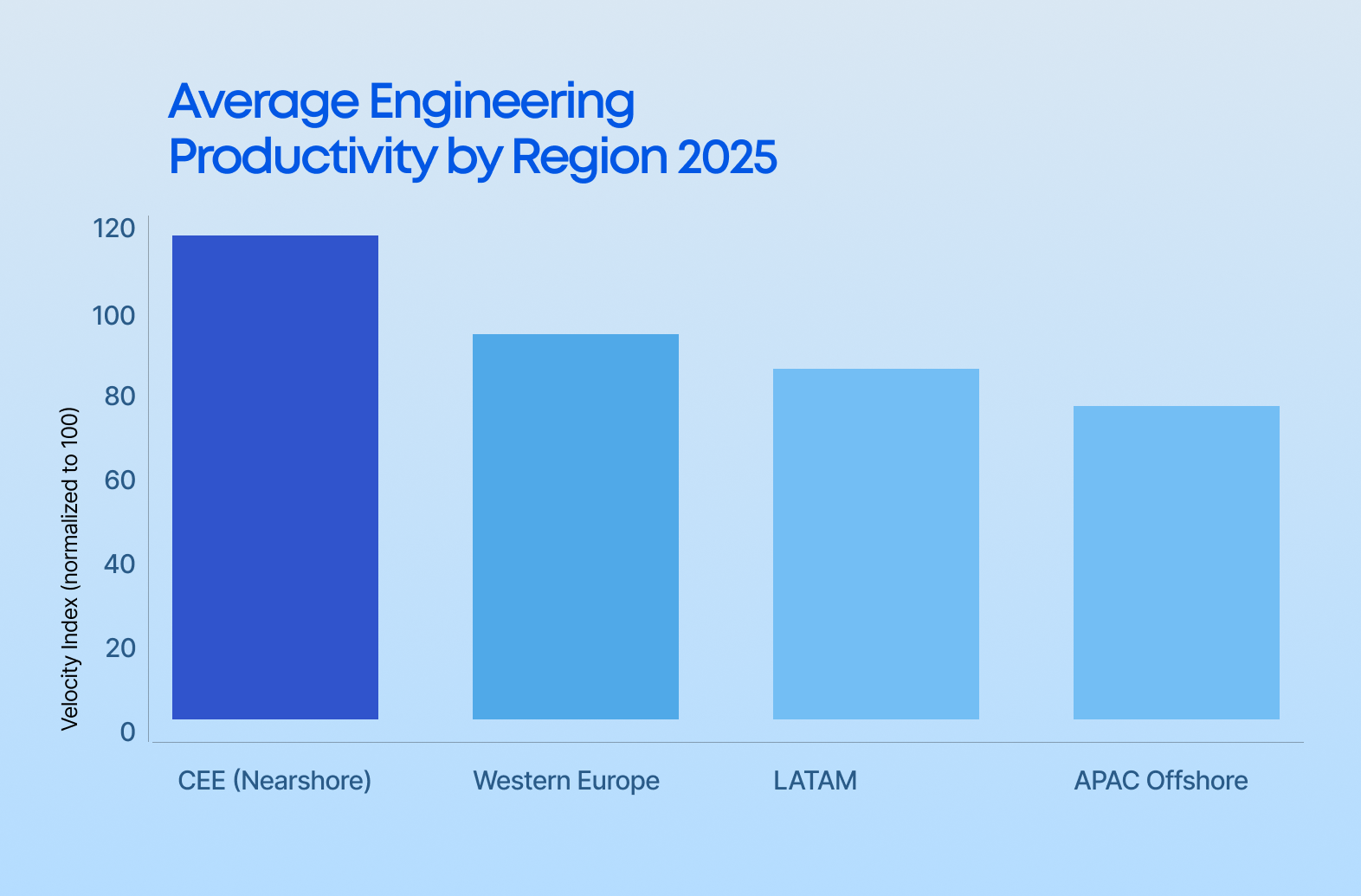
Distributed productivity is also a function of regional capability. CEE markets (Romania, Poland, Hungary, and Bulgaria) consistently rank in the top decile globally for technical depth and English proficiency. When operating under a B-O-T or dedicated nearshore framework, these teams deliver near-onshore parity in cycle time while maintaining 20–40% cost advantage.
Productivity as a System: Beyond Individual Output
True productivity emerges from systems, not heroics.
In high-performing distributed organizations, several systemic enablers consistently appear:
- Unified engineering playbooks: pre-defined PR rules, CI/CD gates, and review checklists.
- Automated metrics dashboards: using DORA-based models in GitHub, GitLab, or Jira to visualize flow efficiency.
- Culture of ownership: local leads empowered to make technical decisions within global alignment.
- Process feedback loops: monthly retros tracking engineering KPIs alongside people metrics (burnout risk, turnover intent).
A mature B-O-T implementation aligns all these levers from day one. By transferring only once operational excellence is quantifiable, not just contractual, the model embeds productivity as a long-term asset, not a transient vendor gain.
The New Productivity Equation
Engineering productivity is no longer measured by hours worked or tickets closed — it’s the intersection of:
Velocity × Quality × Alignment
A well-implemented nearshore or BOT model converts global distribution into a strategic multiplier, not a coordination tax.
However, the cultural component matters as much as tooling. A GitHub report on The State of Distributed Development 2024 found that trust and autonomy ranked higher than compensation or tooling in predicting developer satisfaction, and satisfaction correlates directly with retention and code quality.
In Carbon’s experience, the teams that sustain top-quartile productivity are the ones that:
- Instrument performance continuously
- Treat process design as an engineering discipline
- Embed learning loops between leadership, ops, and engineers
These are not just “good practices”, but systems of compounding advantage.
Building the Future of High-Velocity Teams
As global talent networks deepen, engineering productivity will increasingly depend on operational architecture rather than geography. The organizations that will experience measurable performance gains in 2026 and beyond will be those that:
- Build distributed systems that scale human collaboration
- Apply engineering metrics not as vanity KPIs but as diagnostic feedback loops
- Use nearshore hubs and BOT structures to align cost, capability, and compliance
For Carbon, our mission is to help companies design distributed teams that perform as one unified organism, wherever they are in the world. When structure drives trust and data drives improvement, productivity is no longer an aspiration, but it’s the inevitable outcome.

Carbon is the go-to staffing specialist for Eastern European and North African technical talent. Trusted by the biggest names in technology and venture capital, Carbon’s hyperlocal expertise makes entering new talent markets for value-seeking global companies possible.
Honouring exceptional talent ®
References:
Google Cloud: DORA State of DevOps Report 2023 [1]
GitLab: Engineering Analytics Report 2024
Atlassian: Engineering Effectiveness Study 2023 [2]
Stack Overflow Developer Survey 2024 – Regional Skills Index [3]
Microsoft Hybrid Work Lab: Productivity Patterns in Distributed Engineering (2024)
GitHub: State of Distributed Development Report 2024

.png)